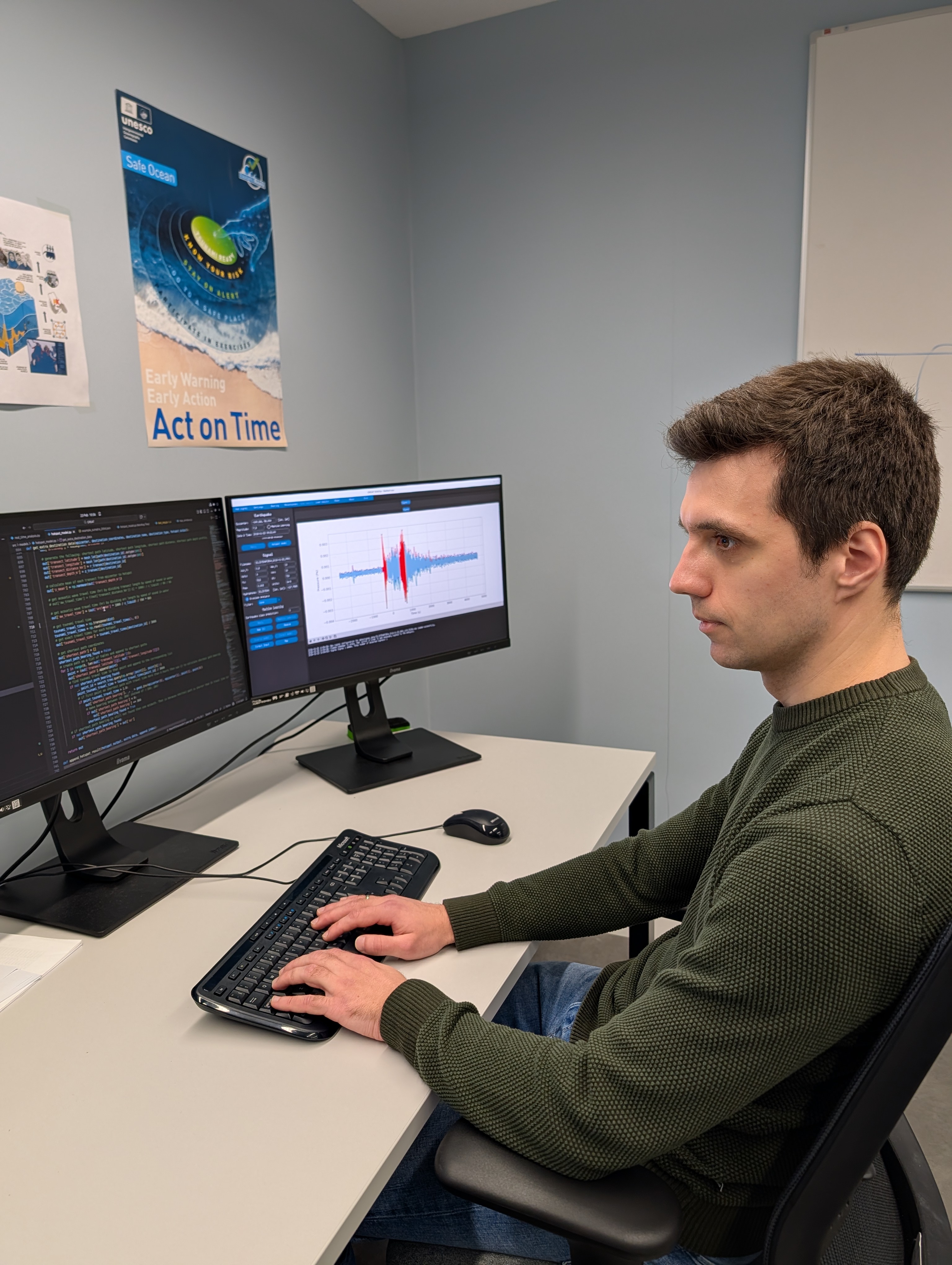
Dr Maxim Filimonov
Postdoctoral Research Associate

Dr Maxim Filimonov

School of Computational and Mathematical Sciences • Cardiff University

I am a Research Associate within Cardiff NLP Group exploring the potential of NLP for real-world applications, as well as enhancing the understanding of NLP technology and language models. I am dedicated to finding creative solutions and have a genuine curiosity and enthusiasm to work with a multi-disciplinary research team in computer science.

Previously, I completed my PhD in Model-Based Systems Engineering at Birmingham City University, and I have been working on a variety of projects as a Research Software Engineer at Cardiff University since 2020.

Dr. Maxim Filimonov

Specializations & Topics

Key Interests

My academic interests bridge statistical learning theory and physically embodied robotic hardware:

Software Engineering

Python, Machine Learning, Backend Development, RESTful APIs, System Architecture & Design.

Artificial Intelligence

NLP, LLMs & Transformers, Prompt Engineering, Vector Embeddings, Retrieval-Augmented Generation.

Data Science

Scientific Methodology & Experimental Design, Quantitative & Statistical Data Analysis, Peer-Reviewed Publications & Technical Writing.

Database Development

NoSQL Database Management, MongoDB, Firebase, Relational Database Systems, SQL.

Model-Based Systems Engineering

MBSE, SysML, AML, Graph Theory, Knowledge Graphs, Semantic Ontologies.

Server Management & DevOps

Linux Systems Administration, Containerization & Composition, Docker, systemd.

Research Focus

Current & Past Projects

I have been involved in a variety of projects.

PROJECT 01 • NLP & AI TEXT ANNOTATION Active Focus

Automatic Text Annotation using LLMs

Web application for automatic annotation of text documents using custom labels.

Keywords: NLP LLM Python Fullstack Development
PROJECT 02 • GREAT Cross-Disciplinary

Global Real-time Early Assessment of Tsunamis (GREAT)

Tsunami warning technology towards a global real-time analysis. The technology is based on the analysis of acoustic signals generated together with the tsunami, due to the compression of the water layer.

Keywords: Python Machine Learning Acoustic-Gravity Waves

Scholarship

Featured Publications

Geoscientific Model Development Journal Paper

GREAT v1.0: Global Real-time Early Assessment of Tsunamis

Usama Kadri, Ali Abdolali and Maxim Filimonov

Geosci. Model Dev., 18, 3487–3507, 2025.

Natural Hazards and Earth System Sciences Journal Paper

Basin-scale geometric focusing: a probabilistic-geometric framework for global tsunami exposure assessment and the 2025 Kamchatka Peninsula tsunami

Ali Abdolali, Michael-Angelo Y.-H. Lam, Usama Kadri, Matt Malej, Maxim Filimonov, and Fengyan Shi

Nat. Hazards Earth Syst. Sci., 26, 3597–3616, 2026.

Bioinformatics Journal Paper

Simulation and annotation of global acronyms

Maxim Filimonov, Daphné Chopard, Irena Spasić

Bioinformatics, Volume 38, Issue 11, June 2022, Pages 3136–3138, 2022.

JMIR Formative Research Journal Paper

Assessing the Feasibility of Using Parents Social Media Conversations to Inform Burn First Aid Interventions: Mixed Methods Study

Verity Bennet, Irena Spasić, Maxim Filimonov, Vigneshwaran Muralidaran, Alison Mary Kemp, Stuart Allen, William John Watkins

JMIR Form Res, 2024.